Microsoft Ignite 2026 wrapped up in San Francisco this week (November 17–20), and if there was one message that came through clearly, it’s this: Microsoft no longer wants to be just the company that sells you Copilot. It wants to be the full platform your business runs AI on: the infrastructure underneath, the data and context in the middle, the agents doing the work, and the security controls that keep all of it in check.
The headlines covered a lot of ground: Copilot as a central hub for work, a new “Microsoft IQ” context layer, agent-driven cloud operations and modernization in Azure, and a long list of identity and security controls built specifically for AI agents. Below, our team breaks down what was announced, what it actually means for IT and business leaders, and what to put on your roadmap now.
The big picture: from AI assistants to AI agents you can govern
Last year’s Ignite introduced the idea of agents working alongside people. This year was about making those agents enterprise-ready, which means giving them identities, permissions, context, runtime environments and guardrails, the same way you manage employees and applications today.
For organizations, that changes the question. It’s no longer “Should we try Copilot?” It’s “How do we run, secure and pay for a growing workforce of AI agents, and is our environment ready for it?”
What Microsoft announced
1. Copilot becomes the hub for work
- Copilot Home (generally available): brings Chat, Cowork and Office capabilities together in a single Copilot app experience.
- Autopilot: a persistent, proactive agent that handles ongoing tasks. It’s rolling out first to customers in Microsoft’s Frontier program.
- Copilot Workspaces: a shared project space where employees and AI agents collaborate on the same work.
- Today (private preview): pulls together mail, calendar, Teams, meetings and tasks in Outlook and the Copilot app, flags what needs attention, and drafts replies and schedule changes for you to approve.
- Copilot Code: expected to reach general availability in the coming weeks.
- Copilot Managed Runtime (generally available): Microsoft-managed hosting for apps built with Copilot, GitHub Copilot and other tools, with Entra identity, governed data access and lifecycle management visible in the Microsoft 365 admin center.
- Salesforce in Copilot (preview): more than 38 prebuilt sales skills plus live access to Salesforce data.
2. Microsoft IQ: the context layer behind every agent
Microsoft introduced Microsoft IQ, a family that combines Work IQ, Fabric IQ, Foundry IQ and Web IQ, with roughly 350 third-party connectors and reusable business plug-ins. The idea is simple: agents are only as useful as the business context they can reach. Microsoft IQ is how your documents, records, systems and outside information get delivered to models and agents in a governed way.
Notable Foundry IQ updates include:
- Knowledge graphs (public preview): map relationships between entities in your enterprise documents and query them in natural language.
- Permission-aware SharePoint integration (generally available): agents can use indexed SharePoint content while respecting existing Entra group and site permissions.
- Foundry IQ Serverless: consumption-based pricing that scales to zero when idle, scheduled for general availability in December.
3. Azure: agentic cloud operations and modernization
- Azure Copilot deployment agent (generally available): turns plain-language requirements into infrastructure and deployment code. Copilot “spaces” and custom skills (public preview) let teams add their own operational knowledge.
- Azure SRE Agent (public preview enhancements): customer-managed keys, Entra Agent ID integration, cross-agent communication and Teams-based investigations across clouds.
- Azure Monitor health models (generally available): connect infrastructure telemetry to application dependencies and business impact, so teams fix what matters most first.
- Azure Resource Manager MCP Server: now goes beyond read-only discovery to creating and updating resources, with every request still subject to Azure Policy.
- Azure Catalyst: a new unified modernization offering that combines Azure Migrate and GitHub Copilot modernization with AI agents to discover, assess, plan and migrate apps, databases and infrastructure, including dependency mapping, cost estimates, landing zone design and migration waves. It adds VMware and Hyper-V migration paths (including to Azure Local), direct migration to Trusted Launch VMs (generally available), and expanded assessments for containers, SQL, Oracle, MongoDB and file servers (mostly in preview).
- Hybrid and multicloud governance: a new Machine Configuration hub with automated security baseline remediation (public preview), extended to AWS and Google Cloud servers onboarded through Azure Arc.
- Infrastructure: Azure Cobalt 200 VMs are generally available, with up to 50% better performance than Cobalt 100, and Microsoft’s distributed PostgreSQL database, HorizonDB, is generally available.
4. Security and identity built for agents
- Entra Agent ID for local agents (public preview): discovers about 60 types of locally running agents, including popular AI coding tools, and gives them identities so they can be governed.
- Automated agent identity lifecycle (generally available): policies check that agents are still active, still needed and have a human sponsor. By default, identities inactive for 60 days are disabled.
- Agent risk assessment and Conditional Access (public preview): tells users apart from agents acting on their behalf, and can restrict risky agents without interrupting the user.
- MCP firewall (public preview): governs how AI agents talk to MCP servers, tools and resources.
- Privileged Identity Management expansion (public preview): just-in-time access to Azure and Arc VMs, with privileged session monitoring and recording.
- Microsoft Perception (generally available): security agents for blue, red and green team work, with guardrails and playbooks.
- Defender and Purview: an integrated security operations center in Defender spanning Microsoft, AWS and Google Cloud; “vulnerability shielding” that buys time before a permanent patch; and enhanced Purview data classification to protect data across both people and agents.
What it means for your organization
1. Agent sprawl is now an identity problem. Agents are showing up everywhere: in Microsoft 365, in developer tools, on laptops. Microsoft’s answer is to treat every agent like a user, with an identity, a sponsor, Conditional Access and a lifecycle. If your Entra ID foundation, access policies and privileged access model aren’t in good shape, AI will amplify those gaps.
2. Your data readiness decides your AI results. Microsoft IQ and permission-aware SharePoint mean agents will surface whatever your users can technically reach. Oversharing, stale content and messy permissions turn into AI risk and bad answers. Data governance, labeling and Purview policies are now prerequisites, not nice-to-haves.
3. Modernization just got faster, and more urgent. Azure Catalyst and the GitHub Copilot modernization tools shorten the path from assessment to migration, including for organizations planning a move off VMware. Every workload left on aging infrastructure is one that can’t take advantage of the AI services Microsoft is building on Azure.
4. IT operations is shifting from doing to supervising. With deployment agents, the SRE Agent and health models, teams will spend less time on manual tickets and more time setting policy, reviewing agent actions and focusing on business impact. That’s a skills and process change as much as a tooling change.
5. Plan for phased, Frontier-first rollouts. Several of the biggest features (like Autopilot) reach Frontier customers first, and many capabilities are still in preview. Expect a staggered timeline, and budget for consumption-based AI costs alongside your existing licensing.
What’s ahead: key dates to watch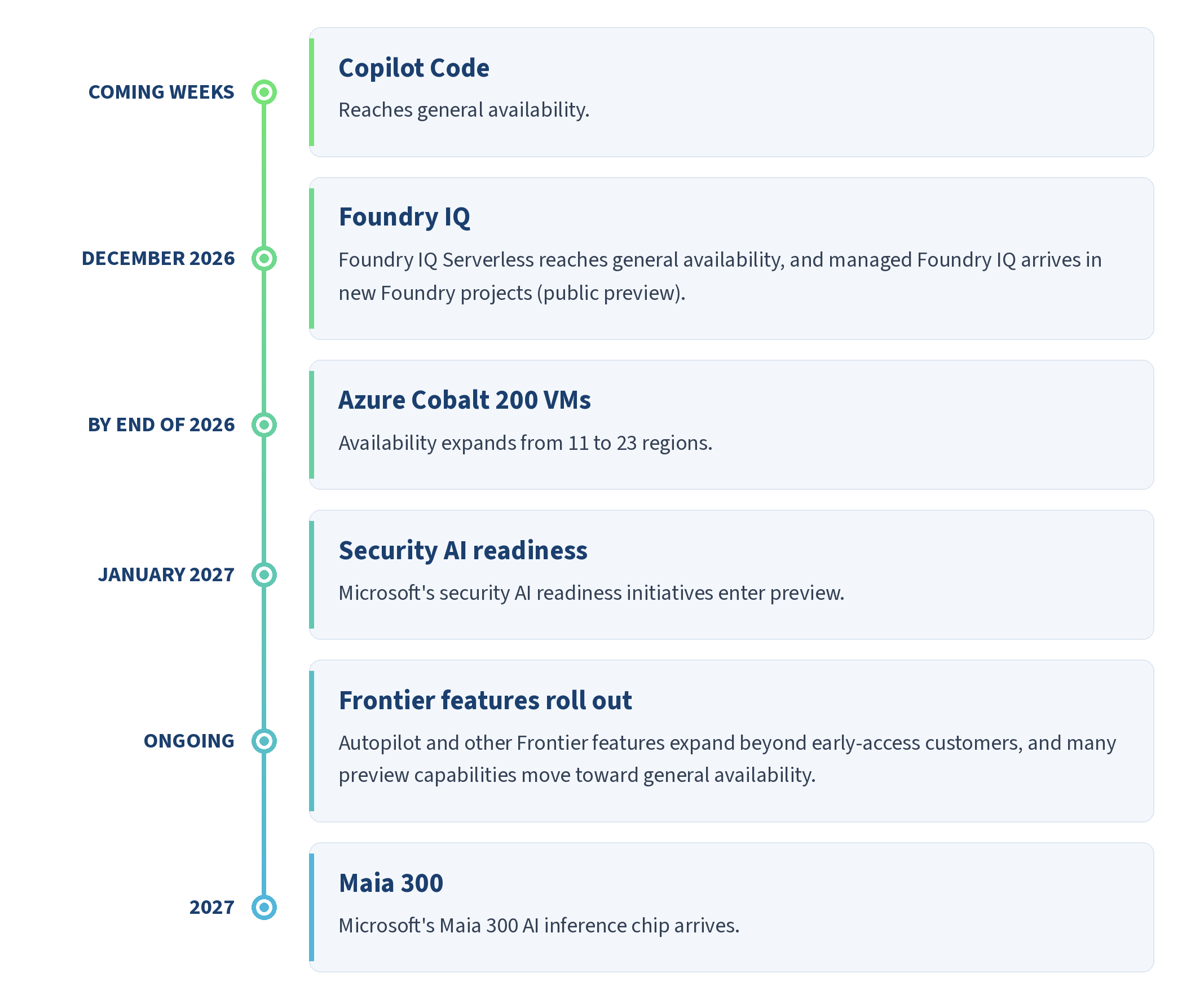
Your post-Ignite action plan: what to do in the next 90 days
- Take inventory of your agents. Find out which AI agents and AI tools are already running in your environment, sanctioned or not.
- Strengthen your identity foundation. Review Entra ID, Conditional Access and privileged access so you’re ready to govern agents the same way you govern people.
- Run a data readiness check. Tighten SharePoint and Teams permissions, address oversharing, and put Purview sensitivity labels and data loss prevention in place before you scale Copilot and agents.
- Refresh your modernization roadmap. Re-evaluate VMware, Hyper-V and legacy app workloads against Azure Catalyst and the new migration paths.
- Pick two or three high-value use cases. Choose specific workflows where Copilot or a custom agent can show measurable results, and pilot them with clear success metrics.
- Build a cost model. Map out licensing and consumption costs for AI so there are no surprises as usage grows.
How Coretek can help
As a Microsoft Azure Expert MSP, Coretek helps organizations turn Ignite announcements into practical results: assessing AI and data readiness, securing identities for people and agents, modernizing infrastructure on Azure, and rolling out Copilot and custom agents that deliver measurable value.
Ready to build your 2027 Microsoft roadmap? Contact the Coretek team to schedule a post-Ignite briefing and find out which of these announcements matter most for your business.